
Data Analyst vs Data Scientist vs AI Engineer: Skills and Careers
Compare data analyst, data scientist and AI engineer careers, skills and projects. Find your learning path with Human Intelligence Labs in Lucknow.
You open a job portal and search for careers in data and AI.
One role asks for Excel and SQL. Another mentions Python, statistics and machine learning. A third expects you to build AI applications, work with APIs and understand deployment.
You close the tabs with more questions than you started with.
Which career suits me? Do I need strong mathematics? Is my degree enough? What if I spend months learning the wrong things?
Choosing a direction becomes easier when you understand the work behind each job title.
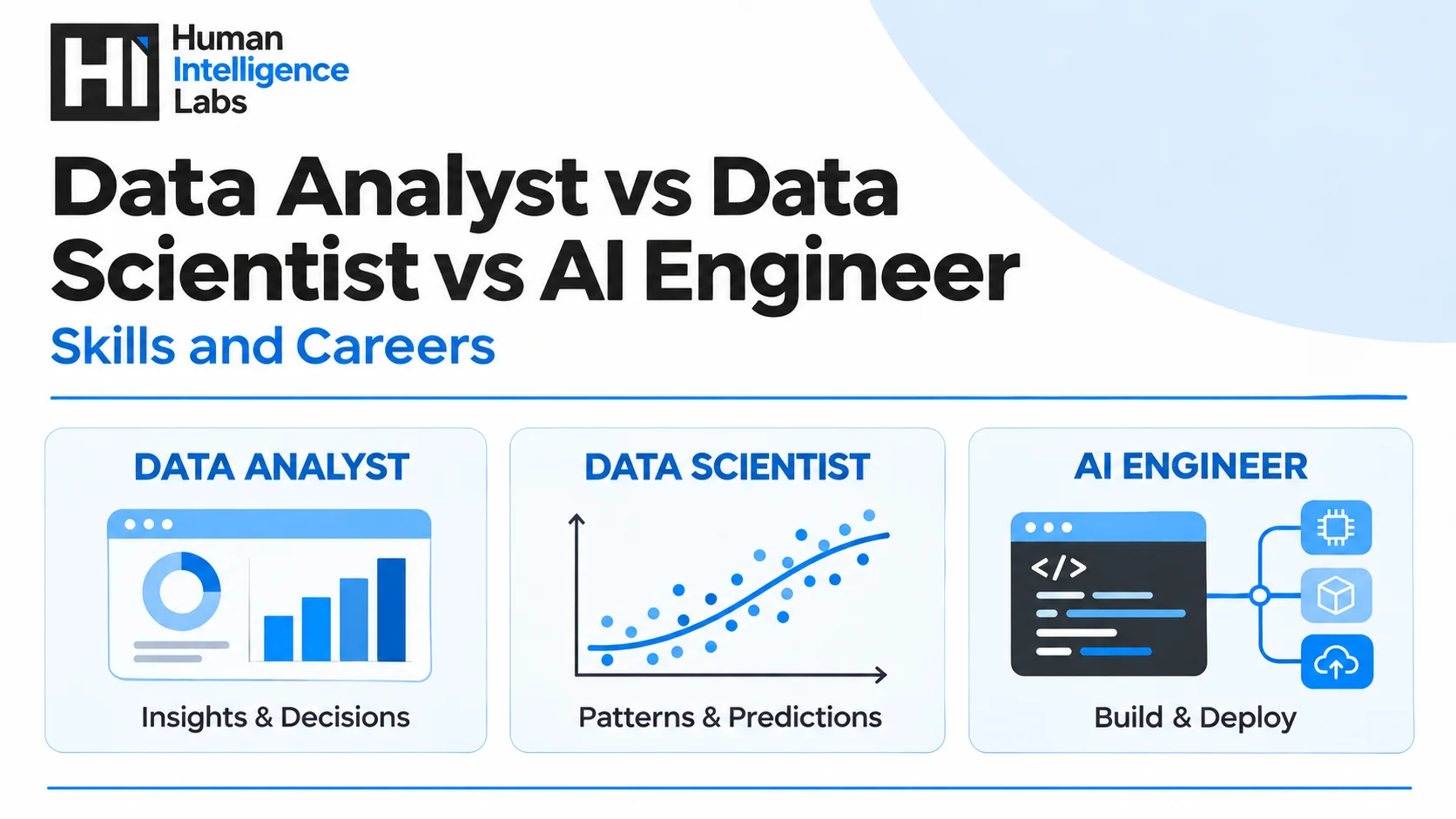
A data analyst helps people understand data and make decisions. A data scientist uses statistical methods and machine learning to investigate problems and build predictive models. An AI engineer builds and maintains software systems that use AI. Responsibilities overlap, and employers may use these titles differently.
Let’s look at what each path means for you.
Data Analyst vs Data Scientist vs AI Engineer: A Quick Comparison
| Career path | Main focus | Core skills | Example project |
|---|---|---|---|
| Data Analyst | Explain business performance and support decisions | Excel, SQL, data cleaning, Power BI, basic statistics and communication | A sales dashboard that explains changes in revenue |
| Data Scientist | Explore patterns, test ideas and build predictive models | Python, SQL, statistics, machine learning and model evaluation | A model that estimates which customers may stop using a service |
| AI Engineer | Build reliable applications and systems using AI | Programming, APIs, software engineering, model integration, testing and deployment | An assistant that answers questions using approved company documents |
You do not need to master all three paths before you begin. Start with the kind of problem you would enjoy solving.
What Does a Data Analyst Do?
Imagine a business owner asks:
“Sales dropped last month. What happened?”
A data analyst might compare product categories, locations, customer groups and time periods to find an explanation. Before creating a dashboard, they need to check whether the data is complete, consistent and suitable for the question.
The work involves preparing data, finding useful patterns and explaining the findings clearly. Microsoft’s data analyst learning resources place similar emphasis on turning data into information that supports business decisions. Explore Microsoft’s data analyst learning path.
Skills to Build
Start with:
- Excel: organise information, use formulas and explore datasets.
- SQL: retrieve, filter and combine data from databases.
- Power BI: build reports and interactive dashboards.
- Statistics: understand averages, variation and misleading comparisons.
- Communication: explain what the findings mean and what their limitations are.
Python can help you automate tasks and analyse larger datasets as your skills develop.
Is Data Analytics Right for You?
This path may suit you if you enjoy asking questions, spotting patterns and explaining why something happened.
A useful first project could be a retail sales analysis. Clean the dataset, write SQL queries, build a dashboard and explain three findings. Include the questions you could not answer with the available data.
That final explanation matters. A dashboard should help someone make a decision.
What Does a Data Scientist Do?
Now imagine the business asks:
“Can we estimate which customers are likely to leave?”
A data scientist might investigate customer behaviour and build a model to estimate that risk. They also need to decide whether the model performs well enough to be useful.
This requires more than running an algorithm. Data scientists must understand the problem, prepare the data, evaluate results and explain their conclusions. Mathematics, computing and communication are important parts of the role. Read the U.S. Bureau of Labor Statistics role overview.
Skills to Build
Focus on:
- Python and SQL for working with data.
- Probability and statistics for reasoning about uncertainty.
- Data preparation for handling missing values and inconsistent records.
- Machine learning for tasks such as prediction and classification.
- Model evaluation for identifying errors, leakage and weak assumptions.
Is Data Science Right for You?
Consider this path if you enjoy investigation, are willing to work on mathematics and want to understand why a model succeeds or fails.
For a customer-churn project, begin with a simple baseline. Compare it with another model, examine the mistakes and explain when the predictions should be treated cautiously.
A portfolio becomes more convincing when you can explain your choices.
What Does an AI Engineer Do?
Suppose the business asks:
“Can we build an assistant that answers questions from our internal documents?”
An AI engineer helps turn that idea into a working application.
The job may involve connecting a model to approved information, building APIs, managing access, evaluating responses and monitoring the application after deployment. Some roles focus on generative AI applications; others involve machine learning systems and infrastructure.
Google Cloud’s machine learning engineering guidance similarly includes building, evaluating, deploying and monitoring AI solutions. Explore Google Cloud’s role description.
Skills to Build
Develop a foundation in:
- Python or another programming language
- APIs, databases and backend development
- Git, testing and debugging
- AI model integration and evaluation
- Deployment, monitoring and access controls
Writing prompts can be useful, but an application also needs to handle incorrect answers, unavailable services and unexpected inputs.
Is AI Engineering Right for You?
This path may suit you if you enjoy coding, building applications and solving problems that appear when real people use your software.
A useful project could be a document-based question-answering assistant. Make it show its sources, test it with difficult questions and check how it responds when the documents do not contain an answer.
Why Students Often Feel Stuck
The difficulty is often knowing what to practise next.
You may recognise these situations:
“I understand the tutorial, but I cannot start a project.”
A guided lesson has already made many decisions for you. Independent work asks you to make those decisions yourself.
“I have certificates, but I struggle in interviews.”
Completing a program and explaining your work are different skills. You need practice discussing assumptions, mistakes and trade-offs.
“Every new AI tool makes my learning plan feel outdated.”
Tools change. Programming fundamentals, data reasoning, testing and clear communication remain useful.
“I do not know whether I am improving.”
Without feedback, it is easy to repeat familiar exercises while avoiding the areas that need attention.
A better learning plan connects each topic to a practical task and gives you opportunities to review your work.
A Practical Way to Move Forward
Choose one small problem before collecting another long list of tools.
For example:
- Analytics: Why are some products selling better than others?
- Data science: Can we predict demand more accurately than a simple average?
- AI engineering: Can users get reliable answers from a specific collection of documents?
Build a first version. Check the results. Ask for feedback. Improve it.
Then document:
- What problem you tried to solve.
- What data or information you used.
- Why you chose your approach.
- What worked and what failed.
- What you would improve next.
The result to aim for is a project you can demonstrate, explain and defend in an interview. That is a more useful milestone than finishing another playlist.
How Human Intelligence Labs Can Help
Human Intelligence Labs is a software development and training institute in Lucknow, focused on AI-enriched learning, practical projects and placement support.
Our approach helps students connect concepts with the work of building, reviewing and explaining solutions.
For Students Interested in Data Analytics
The Data Analytics & Gen AI Program covers Excel, SQL, Python, statistics, Power BI and Generative AI, followed by capstone work and placement preparation.
This is a relevant option if you want to explore how data supports business decisions.
For Students Interested in Data Science
The Data Science & AI/ML Program focuses on Python, statistics, data preparation and applied machine learning, with practical datasets and capstone work.
It offers a structured direction for learners interested in investigating data and building models.
For Students Interested in Building AI Applications
The AI Enriched Software Engineering Program develops software engineering foundations through full-stack projects, modern AI tools and mentor feedback.
These foundations are relevant to AI application development. The requirements of a particular AI engineering role may also call for further study in machine learning, cloud systems or deployment.
For software graduates who need more support with projects, interview preparation and career readiness, the Career Launcher Program is another option to discuss with our team.
What Progress Should Look Like
Look for improvements you can demonstrate:
- You can begin a project without following every step of a tutorial.
- You can explain your code, analysis or model.
- You can respond to feedback and correct mistakes.
- You can present a portfolio with clear documentation.
- You can discuss your work more confidently in interviews.
These are learning goals, rather than promised employment outcomes. Placement support helps you prepare and pursue opportunities; hiring decisions depend on your skills, performance and employer requirements.
Frequently Asked Questions
Which is better: data analyst, data scientist or AI engineer?
The better choice depends on your interests. Data analytics focuses on understanding information and supporting decisions. Data science adds deeper statistical investigation and modelling. AI engineering focuses on building working software systems that use AI.
Can a beginner start with data analytics?
Yes. Excel, basic statistics and SQL provide a practical starting point. You will still need consistent practice, projects and feedback to develop confidence.
Do I need mathematics for data science?
Statistics, probability and other mathematical foundations are important. You can build these skills gradually alongside Python and practical exercises.
Can I become an AI engineer by learning prompt engineering alone?
Prompting is one skill. AI engineering also requires programming, data handling, testing, integration and deployment skills, depending on the role.
Can I move from data analytics into data science later?
Yes, the skills overlap. You would usually need to strengthen Python, statistics, machine learning and model evaluation rather than assume the transition happens automatically.
How can I choose a training program in Lucknow?
Compare the curriculum, practical work, mentor feedback, time commitment and career support. Ask what you will build and how your progress will be assessed before enrolling.
Choose Your Next Step With Clarity
You do not need to decide your entire career today. You need a clear next step that matches your interests and current skills.
If you are comparing data analytics, data science or AI-enriched software engineering training in Lucknow, talk to an admission counsellor at Human Intelligence Labs.
Tell us what you have studied, what you enjoy and where you feel stuck. We can help you compare the programs and understand what each learning path involves.